
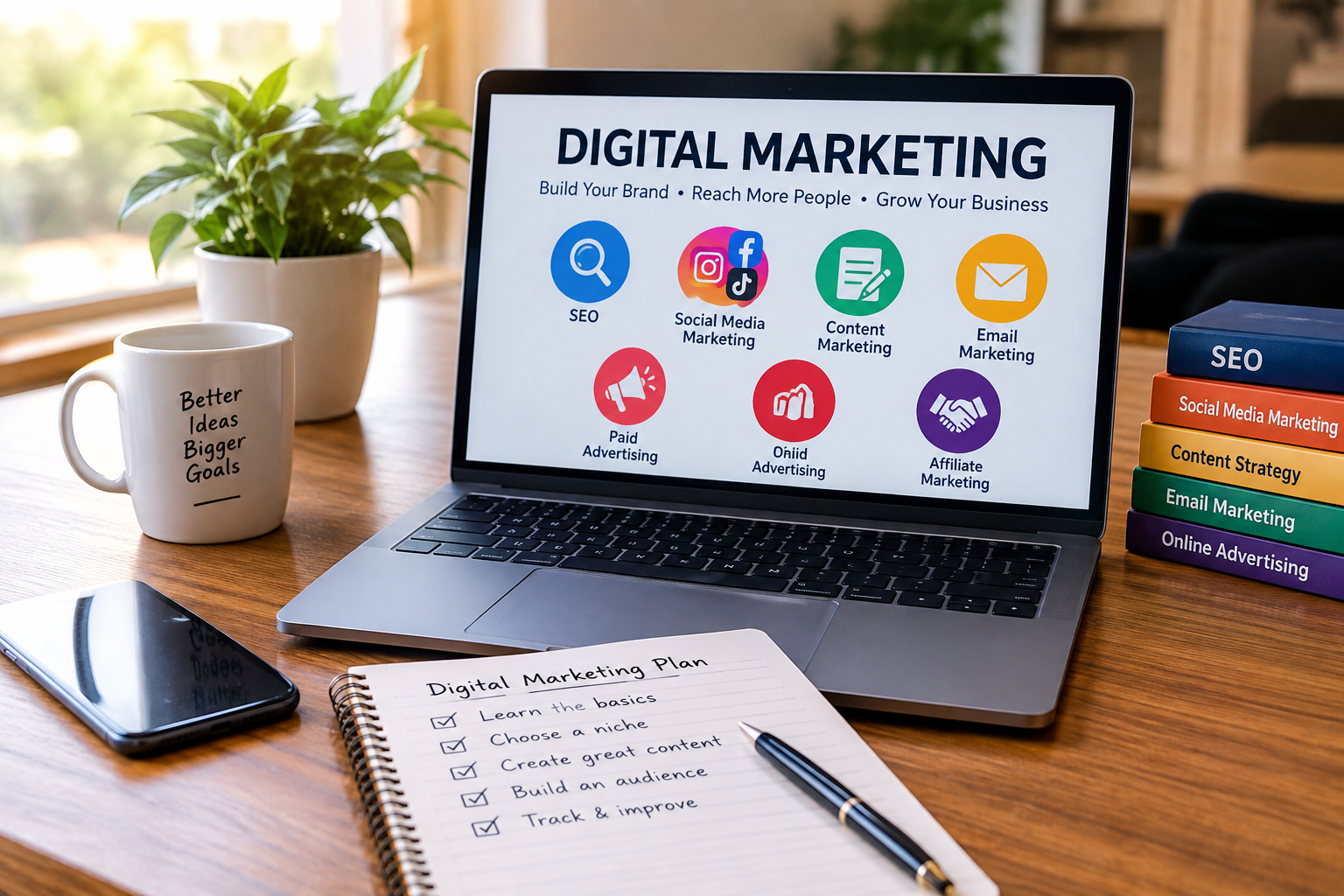
Digital marketing has become one of the most important ways businesses reach customers today. Whether you are running a small business, building a personal brand, selling products online, or simply trying to learn a new skill, understanding digital marketing can give you a major advantage.
Unlike traditional marketing, which relies heavily on newspapers, television, radio, billboards, and other offline channels, digital marketing allows businesses to connect with people through the internet and digital devices.
But what exactly is digital marketing, how does it work, and how can a beginner get started?
In this guide, we’ll break down everything you need to know about digital marketing in simple terms.
What Is Digital Marketing?
Digital marketing is the process of promoting a product, service, business, or brand through digital channels such as search engines, websites, social media platforms, email, mobile applications, and online advertising.
In simple terms, digital marketing is marketing that happens through the internet and other digital technologies.
For example, imagine you own an online clothing store.
You could use Google to help people discover your website, Instagram to showcase your clothes, Facebook advertising to reach potential customers, email marketing to communicate with existing customers, and useful blog articles to attract people searching for fashion advice.
All of these activities can be part of a digital marketing strategy.
The goal isn’t simply to get people to see your business. Effective digital marketing is about attracting the right audience, building trust, encouraging people to take action, and eventually turning interested visitors into customers.
Why Is Digital Marketing Important?
People spend a significant amount of their time online. They search for information on Google, watch videos, use social media, read websites, compare products, communicate through email, and shop online.
This creates a huge opportunity for businesses.
Instead of waiting for customers to discover your business through traditional advertising, digital marketing allows you to actively reach people who are interested in what you offer.
Another major advantage is that digital marketing can be measurable.
With traditional advertising, it can sometimes be difficult to know exactly how many people saw an advertisement and what they did afterward.
With digital marketing, businesses can often track information such as website visits, clicks, leads, purchases, engagement, and advertising performance.
This information helps marketers understand what is working and what needs to be improved.
How Does Digital Marketing Work?
Digital marketing usually starts with identifying a specific audience.
Before promoting anything, a business needs to understand who its potential customers are.
For example, a company selling fitness equipment might target people interested in exercise, home workouts, bodybuilding, or healthy living.
Once the target audience has been identified, the business can choose the digital channels that are most likely to reach those people.
The process can look something like this:
Identify your audience → Create useful content → Reach the audience → Build trust → Encourage action → Measure the results → Improve the strategy
The action you want a customer to take could be purchasing a product, signing up for a newsletter, downloading an application, booking a service, requesting information, or filling out a form.
The Main Types of Digital Marketing
Digital marketing isn’t just one activity. It includes several different strategies that businesses can use depending on their goals.
1. Search Engine Optimization (SEO)
Search Engine Optimization, commonly called SEO, is the process of improving a website so that it has a better chance of appearing in search engine results.
For example, suppose someone searches Google for:
“Best accounting software for small businesses.”
Several websites may appear in the results.
Businesses use SEO techniques to increase the chances that their website will appear when potential customers search for relevant topics.
SEO can involve keyword research, useful content, website structure, page speed, links, technical improvements, and other factors.
One of the biggest benefits of SEO is that it can generate organic traffic without requiring you to pay for every individual click.
However, SEO usually takes time. It is generally a long-term strategy rather than something that produces immediate results.
2. Content Marketing
Content marketing involves creating and sharing useful information to attract and educate a target audience.
Content can include:
– Blog articles
– Videos
– Guides
– Tutorials
– Infographics
– Podcasts
– Social media posts
– Case studies
– Ebooks
For example, a company selling cameras could publish an article explaining how beginners can choose their first camera.
The article may not immediately result in a sale, but it can introduce the company to people who are interested in photography.
Good content helps businesses demonstrate knowledge, answer questions, build credibility, and develop relationships with potential customers.
3. Social Media Marketing
Social media marketing involves using platforms such as Facebook, Instagram, TikTok, LinkedIn, YouTube, and other social networks to promote a business or build a brand.
Businesses can use social media to share educational content, demonstrate products, communicate with customers, build communities, and drive traffic to their websites.
For example, a restaurant could post videos showing how its meals are prepared.
A software company could create tutorials showing people how to use its product.
A personal brand could share educational posts and industry insights.
The important thing is not simply to post constantly. The content should have a purpose and be relevant to the audience.
4. Email Marketing
Email marketing is another powerful digital marketing strategy.
It involves communicating with people through email, usually after they have voluntarily provided their email address.
Businesses can use email to send newsletters, educational information, product announcements, special offers, reminders, and other useful messages.
For example, an online store could allow visitors to subscribe to its newsletter. The business could then send subscribers product updates and useful information.
Email marketing can be particularly valuable because a business can develop an ongoing relationship with its audience instead of relying entirely on social media algorithms.
5. Paid Digital Advertising
Businesses can also pay to advertise online.
Paid advertising can appear on search engines, social media platforms, websites, video platforms, and other digital channels.
For example, a business could create a Facebook or Instagram advertisement targeting people interested in a particular product.
Search advertising can also allow businesses to reach people who are actively searching for specific products or services.
One advantage of digital advertising is targeting. Depending on the platform, advertisers can often choose audiences based on factors such as interests, location, demographics, search behavior, or previous interactions.
However, paid advertising should be approached carefully because spending money does not automatically guarantee profitable results.
6. Affiliate Marketing
Affiliate marketing is another area closely connected to digital marketing.
In affiliate marketing, a person or company promotes another company’s product or service and may receive a commission when a qualifying action occurs through their referral.
The action could be a purchase, registration, lead, or another conversion depending on the affiliate program.
For example, a blogger could write an article reviewing several software products and include affiliate links.
If a reader clicks an affiliate link and completes a qualifying action, the blogger may receive a commission.
Affiliate marketing can be attractive to content creators because it allows them to monetize an audience without creating their own products.
Digital Marketing Example
Let’s look at a simple example.
Imagine Sarah owns an online business selling skincare products.
She could create a website containing information about her products. She could then publish articles answering common skincare questions.
She might use SEO to attract people searching for skincare information.
At the same time, Sarah could create short videos for TikTok and Instagram demonstrating how her products are used.
She could collect email addresses from interested visitors and send them useful skincare tips.
She could also run paid advertisements to reach potential customers.
Now Sarah isn’t depending on a single marketing channel.
Instead, several digital marketing strategies are working together to attract people, educate them, build trust, and encourage purchases.
What Is a Digital Marketing Funnel?
A digital marketing funnel describes the journey a person can take from discovering a business to becoming a customer.
The first stage is usually awareness.
At this stage, people may not know the business exists. They might discover it through Google, social media, a video, an advertisement, or a blog article.
The next stage is interest.
The person begins learning more about the product or service.
After that comes consideration. The potential customer may compare different options, read reviews, visit websites, or look at pricing.
Eventually, the person may reach the conversion stage and purchase a product, register for a service, or complete another desired action.
After the conversion, businesses can continue communicating with customers to encourage repeat purchases and build loyalty.
How Can Beginners Get Started With Digital Marketing?
You don’t need to master every part of digital marketing at once.
A better approach is to start with one area and gradually expand your knowledge.
Step 1: Learn the Fundamentals
Start by understanding basic concepts such as target audiences, customer journeys, content, SEO, conversion rates, advertising, and analytics.
Step 2: Choose an Area to Focus On
You could begin with SEO, content creation, social media marketing, email marketing, paid advertising, or affiliate marketing.
Choose something that matches your interests and goals.
Step 3: Create Something
Theory is useful, but practical experience is extremely important.
Create a simple website, start a blog, build a social media page, or develop a small project where you can apply what you’re learning.
Step 4: Study Your Results
Digital marketing involves testing.
Look at which content attracts visitors, which posts receive engagement, which advertisements generate results, and which pages encourage people to take action.
Then use the information to improve your strategy.
Step 5: Keep Learning
Digital marketing changes continuously.
Search engines update their algorithms. Social media platforms introduce new features. Advertising systems change. Consumer behavior evolves.
Successful marketers therefore continue learning and experimenting.
Common Digital Marketing Mistakes Beginners Should Avoid
One common mistake is trying to use every platform at the same time.
You don’t necessarily need to be everywhere. It is often better to choose a few channels where your target audience is active and become good at using them.
Another mistake is focusing only on selling.
People don’t want to see endless advertisements. Providing useful information can help you build trust before asking someone to buy.
Beginners should also avoid expecting instant results.
Some strategies, particularly SEO and content marketing, can take considerable time to produce meaningful results.
Finally, don’t ignore data.
Without measuring performance, it becomes difficult to understand whether your marketing activities are actually working.
The Future of Digital Marketing
Digital marketing will continue to evolve as technology and consumer behavior change.
Artificial intelligence, automation, short-form video, personalized content, voice search, data analytics, and other technologies are already changing how businesses communicate with customers.
But despite these changes, the basic principle remains the same:
Understand your audience, provide value, build trust, and make it easy for people to take action.
Technology may change the tools marketers use, but businesses will always need effective ways to communicate with potential customers.
Final Thoughts
Digital marketing may seem complicated when you’re first introduced to it, but the basic idea is relatively simple.
It is about using digital channels to connect businesses with people.
Whether you’re interested in starting a business, becoming a content creator, working in marketing, promoting affiliate products, or developing a valuable online skill, learning digital marketing can open many opportunities.
You don’t need to learn everything in one day.
Start with the fundamentals, choose one area to focus on, practice what you learn, measure your results, and improve over time.
The most important step is simply to begin.
Digital marketing isn’t just about getting attention. It’s about reaching the right people, providing value, building relationships, and turning those relationships into meaningful results.